Occult and Cursed Objects List

Bless and curse in the various forms of the words, along with numerous references to cursed objects, are found in the Bible many hundreds of times, in both the Old Testament and the New. This list contains many of those Bible references and there are more besides.

Some Christians today believe that the New Testament has replaced the Old and we should not pay too much heed to what the Old Testament says. Yet the New Testament contains approximately 250 express Old Testament quotations, and more than 1000 indirect or partial quotations.

The Old Testament is quoted in the New Testament at least 295 times, occupying some 352 verses of the New Testament, or more than 4.4 per cent. Therefore, one verse in 22.5 of the New Testament is a quotation from the Old Testament.

All scripture is given by inspiration of God, and is profitable for doctrine, for reproof, for correction, for instruction in righteousness: That the man of God may be perfect, thoroughly furnished unto all good works.” (2 Timothy 3:16-17)

[The Occult and Cursed Object List itself begins about one-third of the way down this article.]

Read More

II. The Activity of Demons

Demons are involved in carrying out Satan’s evil plans (2 Cor.11:15).  What Satan is said to be doing (see above) is their work directly.

1. Demons promote idolatry (Lev.17:7; Deut.32:17; Ps.106:36-38).  This activity is blatant in primitive cultures.

2. Demons are active in hindering the spiritual progress of believers every way they can (see Satan’s activities).  They are deliberate and organized in these attempts (Eph.6:10-12).

3. Demons promote false teaching (1 Tim.4:1).

4. Demons can possess and afflict people (see article on Deliverance).

(a) They cause physical ailments (dumbness – Matt.9:32,33; blindness – Matt.12:22;  convulsions – Matt.17:15-18; Mark 9:20; self-injury – Mark 5:5; 9:22).

(b) They cause mental disorders (withdrawal, nudity, filth, irrational behavior – Luke 8:27-29; suicidal mania – Mark 9:22).

(c) They inflict problems upon believers as well, if allowed by God (Job’s troubles – Job 2:7-9; Paul’s “thorn in the flesh: – 2 Cor.17:7).

5. Demons promote selfishness and division in the church (James 3:13-16): “Who is a wise man and endued with knowledge among you? let him shew out of a good conversation his works with meekness of wisdom.  But if ye have bitter envying and strife in your hearts, glory not, and lie not against the truth. This wisdom descendeth not from above, but is earthly, sensual, devilish.”

This article is written by: Sid Litke, Th.M., a 1984 graduate of Dallas Theological Seminary, currently pastoring the Open Door Bible Church in Port Washington, Wisconsin:  http://www.odbcport.org/index.htm

Read More

C. The Doctrine of Demons

(I) The Existence and Nature of Demons

1. Their Creation:

God created demons as part of the angelic realm originally (Col.1:16).

2. Their Fall:

(a) The evidence

It is clear that Satan has a following of like beings  (“Prince of the demons” – Matt.12:24; the Devil and his angels –  Matt.25:41).

Demons are described throughout the Scriptures (Dan.10:10-20; Matt.10:1; Eph.6:12).

(b) The Time

At the fall of Satan, many angels followed him in that rebellion (demons are fallen angels).  A third of the angelic host seem to have fallen with Satan (Rev.12:4 – the imagery of Satan as a “dragon” and angels/demons as “stars”).

3. Their Nature:

(a) Demons are by nature the same kind of spirit beings as angels.  They are personal, intelligent beings.

(b) Demons are morally wicked (“unclean spirits” – Matt.10:1; “evil” – Luke 7:21; “wickedness/darkness” – Eph.6:12).

(i) They are deceitful (1 Tim.4:1-3; 2 Cor.11:13-15).

(ii) They are immoral (Gen.6:4; Jude 6,7).

3.     Demons are invisible but also able to appear (Satan – Zech.3:1; Matt.4:9.10; Demons – Rev.9:7-10; 16:13-16).

4.     Demons have great intelligence.  They knew Christ’s identity and power (Mark 1:14,34; 5:6,7).  They know their own future judgment (Matt.8:28,29).  They can attempt to predict the future (Acts 16:16). Their knowledge is not infinite. They learned it through thousands of years of experience and observation.

5.     Demons have great strength (Mark 5:3; Acts 19:16; Rev.9:1-11).

Read More

V. The Activity of Satan

Satan is seeking to oppose God’s plan by promoting evil in every way possible:

(1) Indirect Activity

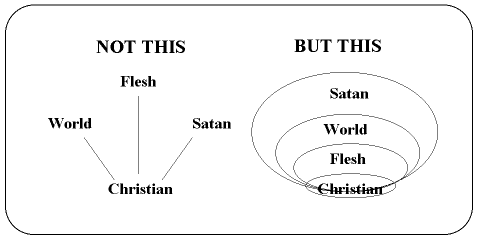
He works indirectly through the world (in which he has great freedom and power – John 12:31; 1 John 5:19) and the flesh (Gal.5:19-21).  The world, the flesh and the devil are not three separate enemies of the Christian.  Rather Satan works through the evil world system (1 John 2:13-15) to exploit the fleshly nature that still wars within us (Rom.7:18; Gal.5:19-21).

(2) Direct Activity

He works directly by deception, temptation, attack and possession.

1. In Christ’s ministry:

(a) He tempted Christ (Matt.4:1-11).

(b) He attempted to thwart Christ’s work (John 8:44; Matt.16:23; Luke 22:31).

(c) He possessed Judas to accomplish the betrayal (John 13:27).

2. In unbelievers

(a) He blinds their minds to hinder their understanding of the gospel (2 Cor.4:4).

(b) When the gospel is heard or understood, he tries to hinder its effect (Luke 8:12).

(c) He uses persecution (Rev.2:10) and false religions (Rev.2:13) to hinder the effect of the gospel.

3. In believers

(a) He tempts believers (to pride – 1 Chron.21:1-8; to materialism – John 2:15; James 5:1-7; to immorality – 1 Cor.7:5; to lie – Acts 5:3; to discouragement – 1 Pet.5:6-10; to be unforgiving – 2 Cor.2:10,11 etc.).

(b) He hinders the ministries of believers (1 Thess.2:18; Rev.2:10).

(c) He promotes false teaching among believers (1 John 4:1-4).

(d) He promotes anger, bitterness and division (Eph.4:26,27; 2 Cor.2:5-11). Note:  See the supplement – “Satanic Activity and Spiritual Warfare” for more information on how Satan and his demons work and how we must respond.

Read More

IV. The Fall of Satan

1. Key Passages – Ezekiel 28; Isaiah 14

2. Ezekiel 28:11-19 is a prophetic lamentation over the “King of Tyre” who is described in language that fits Satan’s fall and not a mere human king.  Satan is distinguished form the human ruler of Tyre in 28:2 (“prince/ruler”) and called a “king” in 28:12 (Not even Israel’s rulers were called “King”).  Though Tyre had a human “ruler”, Satan was the real “King” behind that wicked kingdom.

3. His attributes – Moral perfection (v.12) Sinless at his creation until his fall (v.15):

(a) His appearance – Perfect in beauty (v.12b,13).

(b) His privileges – Free access to the garden of Eden (v.12) and to God’s holy mountain (= God’s presence – v.14).

(c) His rank – “Cherub” (vs.14,16).

4. His judgment:

(a) Cast out of the mountain of God (v.16, cf. Rev12:4).

(b) Cast to the ground (v.17).

(c) Consumed by fire (v.18, cf. Rev.20:10).

5. Isaiah 14:12-15 also seems to describe Satan’s fall.  Satan is manifest here by the king of Babylon.  As in Ezekiel 28, Satan is pictured here as the real “king” behind the wicked human kingdom of Babylon:

(a) The imagery of a “star” and “falling from heaven” (v.12) suggests a supernatural fulfilment.  “Stars” (v.12,13) are symbolic of the angelic realm elsewhere (Job 38:6,7; Rev.12:4).

(b) The five “I will’s” of vss. 13 & 14 are literally true of Satan and only metaphorically true of Babylon’s king.  This ultimate form of pride (“I will be like the Most High” – v.14) fits the New Testament description of Satan’s fall 1 Tim.3:6.

Read More

II. Personality and Names of Satan

1. Personality: He has intellect (2 Cor.11:3), emotions (Rev.12:17) and will (2 Tim.2:26).

2. Names: He is called Satan, the Devil (slanderer), Lucifer (son of the morning), Beelzebub (Lord of the flies – Matt.12:24), and Belial (lawless – 2 Cor.6:15), the evil one (1 John 5:19), the tempter (1 Thess.3:5), the prince of this world (John 12:31), the god of this age (2 Cor.4:4), the prince of the power of the air (Eph.2:2), the accuser of the brethren (Rev.12:10), and angel of light (false light – 2 Cor.11:14), a serpent (Rev.12:9), and a dragon (Rev.12:3).

Read More

III.  The Ministries of Angels

1. They worship God. Angels are continually involved in praising God (Rev.4:6-11) through describing His attributes (Is.6:3) and singing praises (Rev.5:8,9).

2. They ministered to Christ. Angels announced His birth (Luke 1:26-33; 2:13), protected Him  (Matt.2:13), strengthened Him (Matt.4:11; Luke 22:43), and explained to men His resurrection (Matt.28:6) and ascension (Acts 1:10,11).

3. They carry out God’s government. Angels are God’s servants (Ps.103:20; Heb.1:7) and messengers (Luke 1:19; 2:8-14).  They can be involved in controlling nature (Rev.7:1; 16:3,8,9), nations (2 Kings 19:35), and Satan and demons (Dan.10:13,21; 12:1).  They will perform future judgment for God (Matt.13:3a; Rev.15:1; 16:1-21).

4. They protect God’s people. Angels are sent to serve believers (Heb.1:14).  They protect the godly (Ps.34:7; Dan.6:20,23), oppose our enemies (Ps.35:4,5) and are specifically assigned as guardians of individuals (Matt.18:10).  They are God’s agents in answering prayer (Acts 12:7) even bringing physical provisions (Gen.21:17-20; 1 Kings 19:5-7).

5. They assist believers at death (Luke 16:22; Jude 9).

Read More

KEEPING FAITH

Our faith isn’t always tested in the good times; our faith is tested during trials and times of challenge.

When we ask, “Where are you, God?” and hear crickets chirping, that’s when we’re left to decide. Will we believe anyway–cultivating a more mature faith? Or will we decide He’s not there, falling back on all the voices we’ve heard in the past?

Sometimes we can see the temptation at work in these moments; sometimes we can’t. We take forward steps and backward steps (and side steps and missteps), but we’re growing when our number of forward steps become greater.

Taking that forward step is your faith in action.

Read More