5. Walk in Truth

Of course, feeling forgiven and making positive changes going forward isn’t always easy. That’s why you must commit to walking in truth.

What sins do you struggle to avoid? What Scriptural truths do you struggle to believe? Find relevant Scripture, write it down, memorize it, and refer to it constantly. Meditate on it day and night until it becomes a part of you and you start living according to it.

Are you struggling with guilt and shame over your past? Memorize Romans 8:1, which says, “Therefore, there is now no condemnation for those who are in Christ Jesus.”

Repeat it to yourself every time those feelings try to creep back in again. Say it out loud if you need to. Write it on your hand if you need to. Spray paint it on your walls if you need to. Whatever it takes for you to be able to proclaim it victoriously.
Read More

4. Forgive Yourself

If God, who is perfect, pure and holy can forgive you – so can you. You are not allowed to hold yourself to a higher standard than God does (as though you were a more righteous judge), and you don’t want to say that Jesus’s blood is insufficient for your sins (it’s not). When God declares you forgiven, you are forgiven. Period. The end.

Read More

3. Seek Freedom from Bondage

Of course, not all sins are easy to break, especially in cases of addiction. This is because, when we allow sin to enter our lives, we give Satan a foothold or a “grasping on point,” from which he can influence and control our lives, and he isn’t going to let it go of it easily. Therefore, if you have sins that are keeping you in spiritual bondage, stronger measures may be needed.

Two of the absolute best resources I know of on spiritual strongholds are the books “The Steps to Freedom in Christ” and “The Bondage Breaker,” both by Neil T. Anderson. I went through both books and “The Steps to Freedom in Christ” study guide in high school, and it absolutely began a period of great healing and transformation in my life. I know it can for you too.

If you have sins you struggle to break free from, I would strongly encourage you to check out one or both books. But don’t stop there. Speak to your pastor, a strong Christian mentor or a trusted Godly friend. Speak to a counselor or doctor, if you need to. Do whatever it takes to find true freedom once and for all. I can promise you, it is hard but it is worth it.

Read More

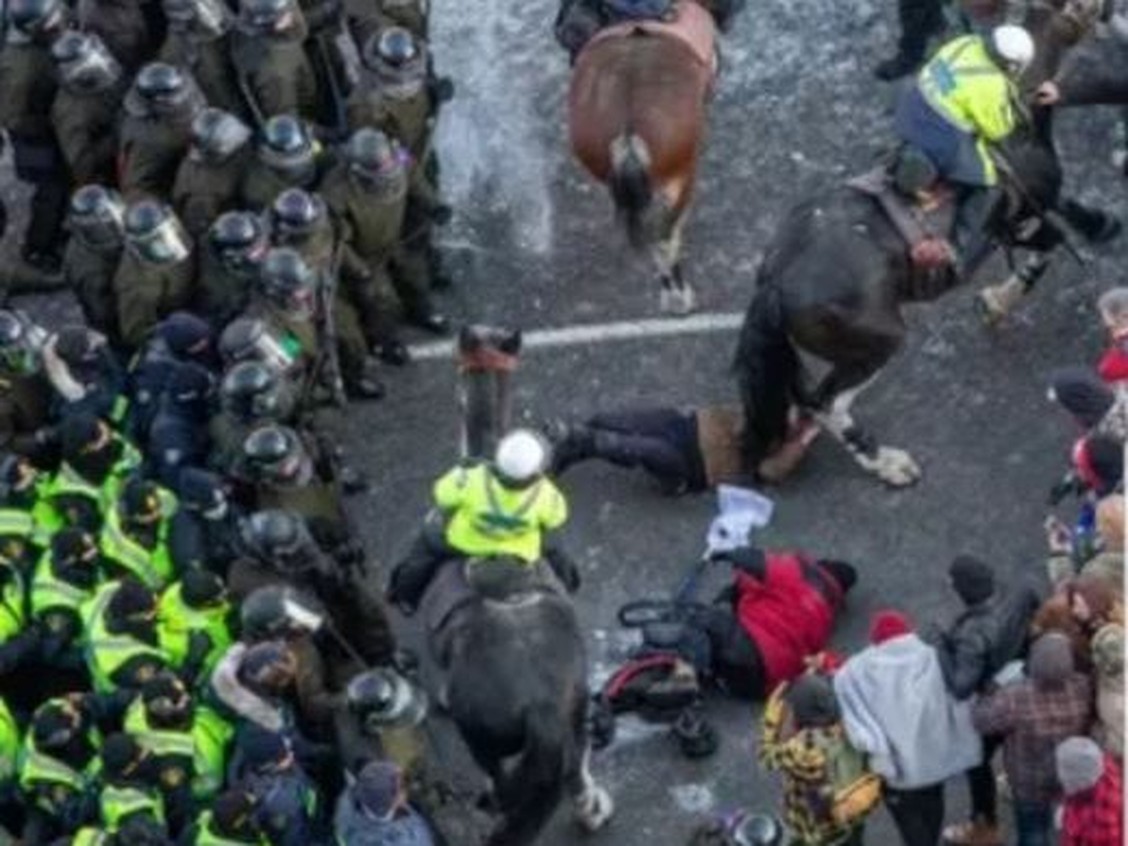
POLICE HORSES TRAMPLE DEMONSTRATORS AT FREEDOM CONVOY PROTEST IN OTTAWA

Turns out the lasting image of the Freedom Convoy protest at Parliament Hill will not be bouncy castles but that of a woman with a walker being trampled by a police horse.

The violence the Prime Minister has expressed concern about during the three-week protest in Ottawa didn’t unfold until Justin Trudeau’s Emergencies Act police army was sent in to disperse the crowd.

The three major incidents Friday, under a form of martial law, were grotesque.

Video of Toronto Police Mounted Unit officers charging into the crowd and at least one horse trampling multiple people — including an elderly woman with a walker — was disturbing.

Read More

Spain’s King Felipe Tests Positive for COVID-19

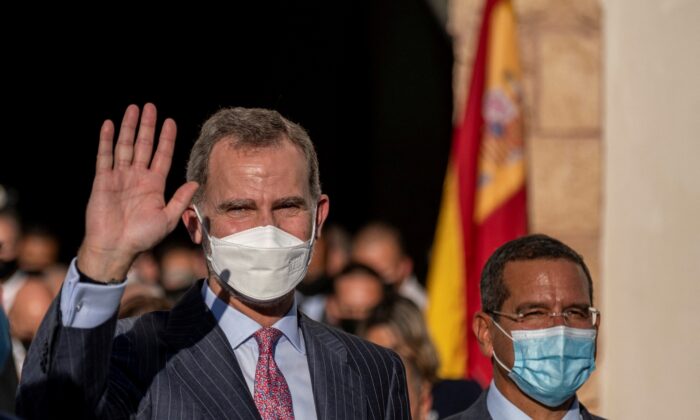
King of Spain, Felipe VI, waves as he leaves the San Jose Church, in San Juan, Puerto Rico, on Jan. 25, 2022. (Ricardo Arduengo/Reuters)

MADRID—Spain’s King Felipe tested positive for COVID-19 earlier on Wednesday after displaying mild symptoms overnight and will remain in isolation for seven days, the Royal Palace said in a statement.

“His Majesty’s general state of health is good and he will keep up his institutional activities from his residence,” it said, adding that Queen Letizia and their daughter Princess Sofia showed no symptoms.

Read More

Transient epileptic amnesia

A distinctive epileptic syndrome typically occurs in late middle age, transient epileptic amnesia is often mistaken for dementia, cerebrovascular disease, or transient global amnesia. The condition is marked by amnestic seizures³ that typically last 15-30 minutes and occur approximately once per month.

While some people only experience amnesia, other manifestations in addition to amnesia include olfactory hallucinations, brief loss of awareness, automatisms (for example, lip-smacking), and, very rarely, tonic-clonic seizures.

The condition has been linked to a group of persistent interictal (between seizures) memory complaints. These include accelerated long-term forgetting, autobiographical amnesia (inability to recall personal memories), and topographical amnesia (difficulty recognizing familiar locations). Antiepileptic treatment⁴ has been shown to control both seizures and interictal memory disturbances.

Read More

Free Yourself From the Past by Understanding Your Emotions and Triggers

When you get triggered in your life now from childhood emotional neglect from the past, you may have little understanding about what you are feeling and why you may fall victim to repeating a dangerous pattern: pushing down your feelings and treating them as unimportant.

To take control over your triggers, it’s crucial to understand your personal childhood emotional neglect experience. Then, go down the path of reconnecting with your feelings and learn how to identify, differentiate, accept, and process them.

Once you take those steps, you’ll still find yourself getting triggered when certain events happen in your life because you are human just like the rest of us! But, with awareness and some emotion skills, you will be the one in control. You will no longer feel confused or ashamed for having responses that don’t make sense to you. Instead, you will find that you make perfect sense.

© Jonice Webb, Ph.D.

Read More

Why does the location of the seizure matter?

Seizures can either be generalized (affecting both sides of the brain) or focal (located or beginning in one small part of the brain). Because seizures can affect different parts and functions of the brain, they don’t all appear the same or have the same long-term consequences.

Take, for example, the hippocampus. This part of the brain is a bit like a highly efficient receptionist. It receives new information, and if it seems valuable, it sends it off to the relevant area of the brain for long-term storage.

When you need that information again, the hippocampus goes to fetch it for you. Seizures that affect this part of the brain can make it more difficult for you to store and retrieve information, even if the areas of the brain that usually store the information are unaffected.

Certain areas of the brain, namely Broca’s area, and Wernicke’s area, are responsible for speech and language. If seizures originate in or affect these areas of your brain, you may have difficulty accessing or understanding certain words.

Read More