
Dear God Who created me, I believe that Jesus Christ, Your Son, died to take away the sins of the world and to give me everlasting life. I want to receive the gift of everlasting life and I want to be washed of my sin of unbelief right now. I am ready to accept and receive Jesus Christ, Son of God as my Lord and Savior. I truly believe in my heart that Jesus Christ has been raised from the dead and is alive now at the right hand of God the Father where Jesus is interceding for me and all believers (Ro 10:9). Once I confess out loud that Jesus is my Lord (Ro 10:9) I am now a born again, adopted child of the Living God (Jn 1:12). God is now my Heavenly Father (Gal 4:6). Father, thank you for saving me through your Son (Ro 10:10) and giving me eternal life (1 Jn 5:12)! I believe and trust that you have washed all my sins of the past away. At this moment, all things have become new. My new life begins now. In Jesus’ name I have prayed, Amen.
Month: June 2023
Do They Have a Future?
Local currencies sound like a good way to keep the money local. In the United Kingdom, however, many that emerged with great expectations have called it quits, in large part because they haven’t kept up with digital payment developments.
But some, like the Bristol Pound in England and the Calgary Dollar in Canada, are.
There are, or have been, more local currencies in the world than we realize — 3,500 to 4,500 such systems in 50 countries in the last few decades — and if the pandemic lingers, those numbers will probably escalate.
Other Towns That Have Launched Their Own Currency
Towns in other countries hammered by the pandemic have taken similar measures.
The Italian town of Castellino del Biferno (population 550) started printing a local currency called the Ducati in April.
In Mexico, the town of the Santa Maria Jajalpa (population about 6,000) has created a new currency, “jajalpesos,” that residents can use to buy local food.
Historically, there’s a strong connection between hard times and the emergence of “community currencies,” visiting Boston University professor Jim Stodder told the Washington Post. “Any time we have a serious downturn in which people are short of money, these things tend to pop up,” he said.
Usually, they stick around for a few years or less and then die out. But some live on. Most notably in the U.S. a community currency called BerkShares has been used in western Massachusetts since 2006.
Is It Really Money?
The authority to print money in the U.S. rests solely with the federal government, and the only legal tender in the country is the U.S. dollar.
So, while the Tenino Wooden Dollar sounds like a great idea, is it legal?
If it really were a competing currency, the answer would be no. But it’s really more like scrip — a certificate that can be exchanged for goods — and scrip has been used by all manner of towns, regions, companies, and organizations for hundreds of years. As long as they are not used to avoid taxes and can be exchanged — or ultimately exchanged — for U.S. dollars, they are legal.
“No one is going to be held accountable for this because they are not actually creating money, as it’s legally defined,” Jesse Kraft of the American Numismatic Society told CNN in evaluating the Tenino currency. “These are just tokens that are creating an economic stimulus.”
Is It Legal for a Town to Create Its Own Currency?

Little Tenino, Washington (population 1,884) has come up with a seemingly novel way to ease the economic pain caused by the coronavirus lockdown: Create the town’s own currency.
Mayor Wayne Fournier was looking for a way to help individuals and families who were hurt when businesses were forced to close down when the idea came to him at a town meeting. During the Great Depression in the 1930s, Tenino had printed its own wooden dollars to help the local economy — why not do it again?
Fournier and city officials decided to reintroduce the wooden currency, using an old printing press to imprint thin sheets of wood with an image of George Washington and the phrase, “habemus autem sub potestate,” which basically means, “We have it under control.”
Here’s how it works: The town set aside $10,000 to assist residents with incomes that fall under the poverty line. Those people become eligible to apply for money from that fund. Instead of receiving cash, however, they get the wooden currency, which comes in notes worth $25 each. Applicants can receive up to 12 per month, or $300, and their use is limited to Tenino merchants who provide essential goods and services, not including liquor, cigarettes, or marijuana. The merchants may then submit redemption requests to the city for real U.S. cash.
Why not just give residents the cash? Because the local currency means that the money stays in the community and is not sent out to Amazon or other online retailers.
Rising from the Desert: A 15-Minute City is Coming to Utah

15-minute cities are a trending urban planning topic that has long been discussed academically and is now slowly being implemented across existing cities in Europe. But now, the first 15-minute city is being designed and built from scratch in Utah. Dubbed “The Point”, the new 600-acre city will be located just outside Salt Lake City, and will be a redeveloped former state prison site where new jobs, housing, public spaces, amenities, and transportation will serve almost 15,000 people in an attempt to explore a prototype for how innovative urban planning concepts can improve the public health and wellness.

While Paris was the first to introduce and take actionable steps toward creating a 15-minute city, its planning principles have quickly caught on in other parts of the globe. In Europe, the goal of redesigning cities in this manner is to make daily tasks more accessible by walking or bike rides, but this isn’t the case in US cities- largely due to the amount of urban sprawl and the resulting reliance on cars to get from place to place. While there have been attempts to become less car-dependent, with projects including a new development underway in Arizona which claims to be a completely car-free zone, The Point in Utah acknowledges that residents will still need access to cars- but just less frequently than in other cities. Instead, they’ve coined the term “one-car community” where they expect families to only need one vehicle per household.
The Point’s vision is to create an iconic community that focuses on healthy living while also creating new jobs and housing that will allow residents to live, work, and play in the same area. By designing for ease of mobility, creating an 18-hour district where there are things to do for a majority of the day, and the right combination of new residential types, office space, and supporting infrastructure, the goal is to be a pioneer in how new cities can be built across the United States in the future.
Ancient extinct skink was orders of magnitude bigger than any skink alive today by Bob Yirka , Phys.org
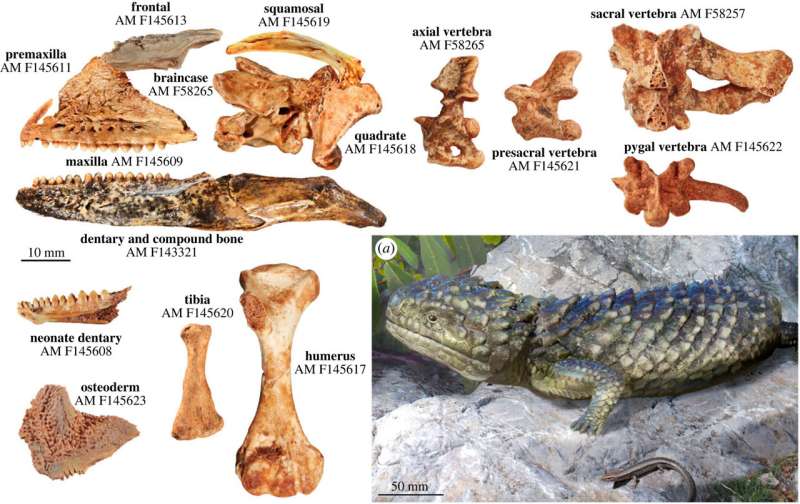
A team of researchers from Flinders University with ties to the South and Western Australian Museums has confirmed the identification of one of the largest ancient lizards ever found. In their paper published in Proceedings of the Royal Society B, the group describes the means by which the specimen was found and identified and its physical characteristics.
In 2016, scientists working at a Wellington Cave dig site in New South Wales, Australia, discovered lizard fossils. Subsequent study suggested that they came from two species of large, ancient lizards. In this new effort, a closer look has shown that all the fossils were those of a single lizard and that it was one of the largest ever found.
Since the initial find, workers at the site have uncovered many more samples of the giant lizard, ranging in age and size. The findings led to comparisons with ancient lizard fossils found at other sites and in museums, which turned out to be the same species of lizard. They found that the lizard species lived from approximately 2 million years ago to around 47,000 years ago.
The species has been named Tiliqua frangens, and in addition to its large size, it has other unique features. The lizards were covered in thick, spikey armor that clearly served as plating to protect them from predators, though such predators would have had to be quite large, as the ancient lizards grew to 60 centimeters in length and weighed up to 2.4 kilograms. For comparison purposes, the researchers note, the largest modern skinks grow to just 35 centimeters and weigh on average 2 grams. They suggest that of modern species, the ancient skink most closely resembles the blue-tongued skink.
7. Disrespecting him
For most men, disrespect is the worst offense.
Most of us cannot stand a partner who belittles us or speaks to us with disdain. Doing this will make us want to avoid you.
6. Not trusting him
Remember the point about us being humans and not angels? Let’s say we did something that made you lose your trust; please try and build it up.
We hate having that feeling that our partner doesn’t trust us.
5. Smothering him with affection
We are men. We appreciate the fact that you love us, and you want to express your love at any opportunity you get.
As you do that, however, remember that we are not exactly babies. We don’t need you monitoring us or stifling us with attention and care.
We still need you to be loving, but remember that too much of everything is bad.
 Persecution Live